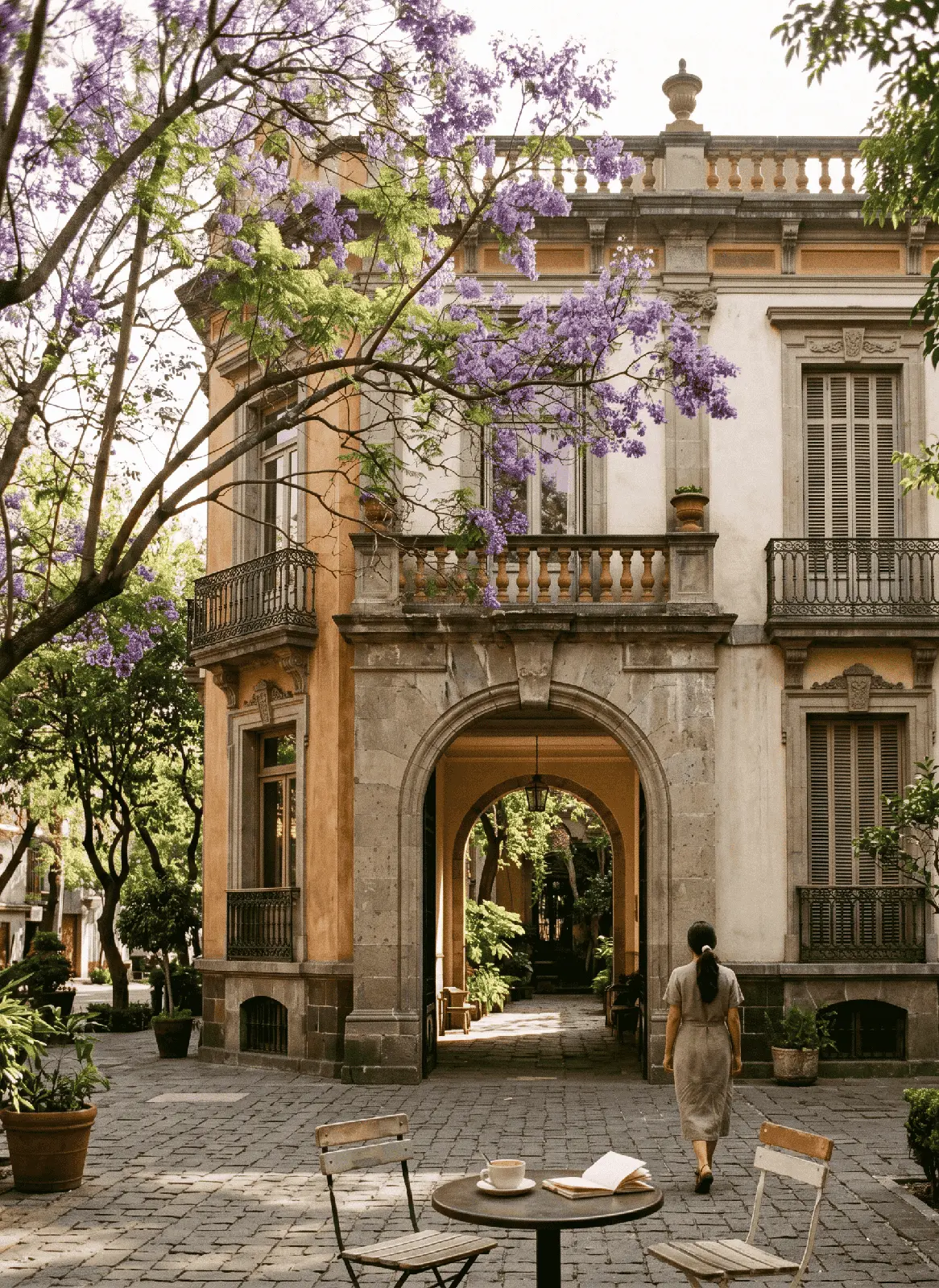
Mexico City does something to borrowed rooms that no other city in this guide quite manages. It makes them adjacent to a courtyard. Not always — there are street-facing rooms in Roma Norte, and rooftop rooms in Condesa, and basement rooms in Coyoacán that face nothing but a wall — but the default mode of the Porfirian apartment building, which is the building type that produces the most interesting rooms in the city, is a room arranged around a courtyard so thoroughly beautiful that the work becomes a secondary priority almost immediately upon arrival.
The courtyard is not, in the abstract, a problem. In the abstract it is a generous architectural feature: light from above, shade at the right hours, a tree in the centre with leaves that move in the late-afternoon wind that arrives in Mexico City at around four without fail, every day, regardless of what the morning was like. The problem is that you are supposed to be working, and the courtyard is making that very difficult, and the jacaranda — if it is March, if you have timed it correctly — is making it impossible.
On the jacaranda, briefly
The jacaranda season in Mexico City runs from roughly February through April, peaking in late March, and it covers the city in a purple that is so specific to the altitude and the light of the plateau that it looks, in photographs, slightly unreal. In a courtyard, at eye level, from a desk that you have positioned near the window specifically to take advantage of the light, it is worse: it is entirely real and entirely consuming and there is nothing to be done about it except to accept that the paragraph you were working on will have to wait until the wind stops moving the branches.
This is not a complaint. It is more of a working condition disclosure.
The rooms that work despite the courtyard
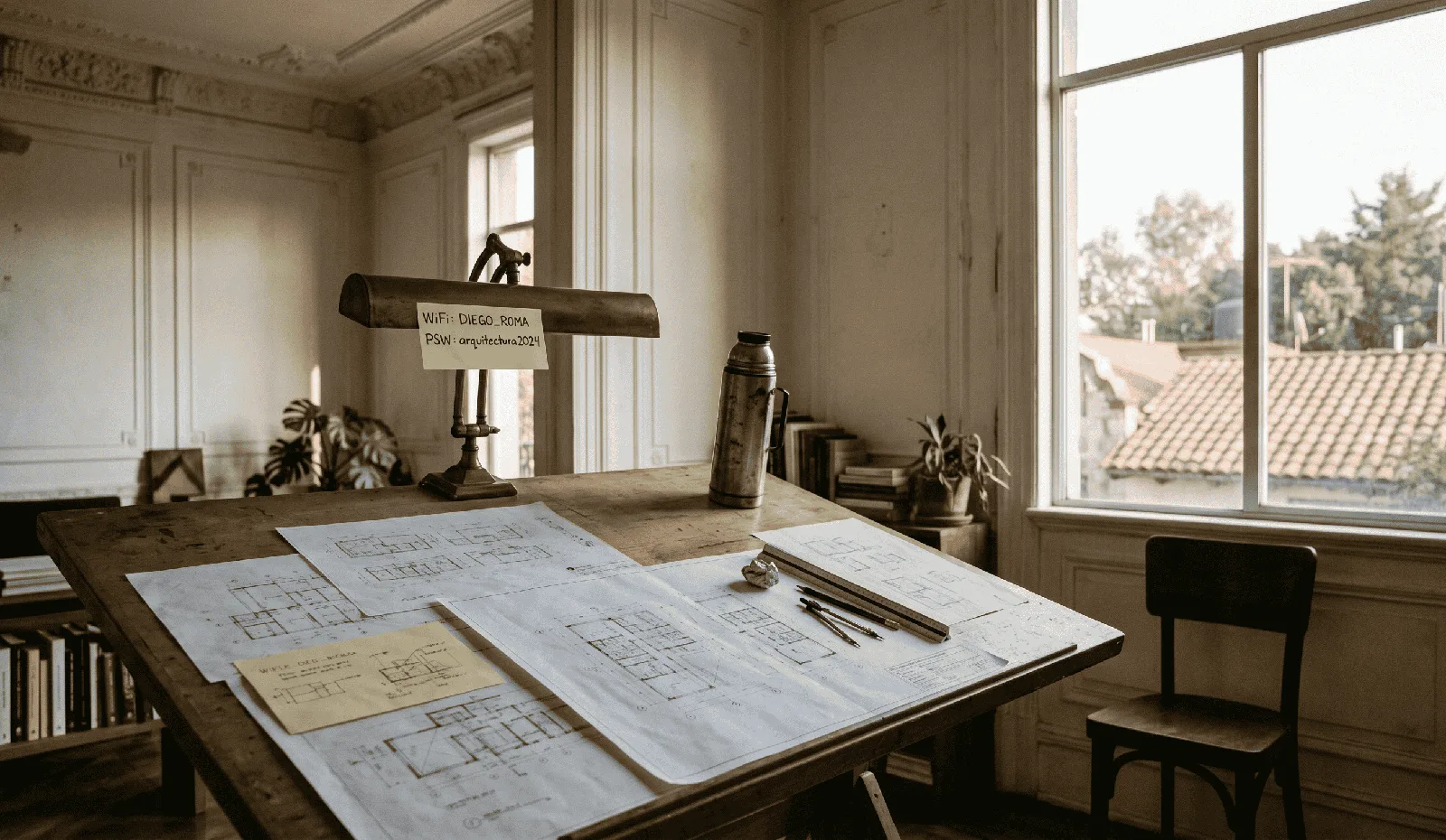
There is a specific configuration of Mexico City room that manages, despite the courtyard, to actually produce work. It requires the desk to face away from the courtyard window — toward the interior wall, toward a bookcase, toward anything that does not involve a tree — and the window to remain visible only in the peripheral vision, where it registers as light rather than as spectacle.
The Mexico City room that works is the one where you can feel the courtyard without having to look at it. The light comes in, the air moves, the tree makes a sound — but none of it requires your full attention. You know it is there. That is enough.
The rooms in Roma Norte that meet this criterion are, in experience, fewer than you would hope. Most of them have been arranged by their owners to face the courtyard — because of course they have; the courtyard is the best thing about the apartment, and if you live in it you want to look at it constantly — and the desks are placed accordingly. Arriving with the intention to work and finding the desk directly facing the jacaranda in March is a particular kind of situation that requires either moving the desk or abandoning the morning to the courtyard entirely.
Neither of these is a bad outcome. Moving the desk requires ten minutes and the host's permission. Abandoning the morning to the courtyard produces, in the afternoon, a quality of attention that is sometimes better than what you would have had if you had simply sat down and started at nine. Mexico City has its own theory of the working day, which is that the morning is for coffee and the city and the courtyard, and the serious work happens in the three hours between two and five, before the earthquake drill or the thunderstorm or the street festival that appears without warning on any given Wednesday afternoon in a neighbourhood that has decided to celebrate something.
What Condesa does differently
Condesa has fewer interior courtyards and more outer-facing rooms — the Art Deco buildings along the park have a different relationship to light, more frontal, more deliberate, the windows designed to face the street rather than an enclosed garden. The working conditions are correspondingly different: more noise from outside, less visual distraction from within, a kind of urban accountability that the courtyard room doesn't enforce.
Condesa rooms are better for certain kinds of work — anything that requires sustained momentum, anything deadline-adjacent, anything where you need to feel that the city is moving and so should you. Roma Norte rooms are better for anything that benefits from a slower rhythm, a longer lunch, the willingness to stop at noon and sit in the courtyard until the jacaranda is finished doing what it is doing and you can go back inside.
Both of these are, in the end, better than most of the alternatives. The courtyard problem is not, it turns out, a problem. It is a feature of working in Mexico City that distinguishes it from anywhere else, and that you will miss, specifically and with some precision, the moment you return to wherever your actual desk is.