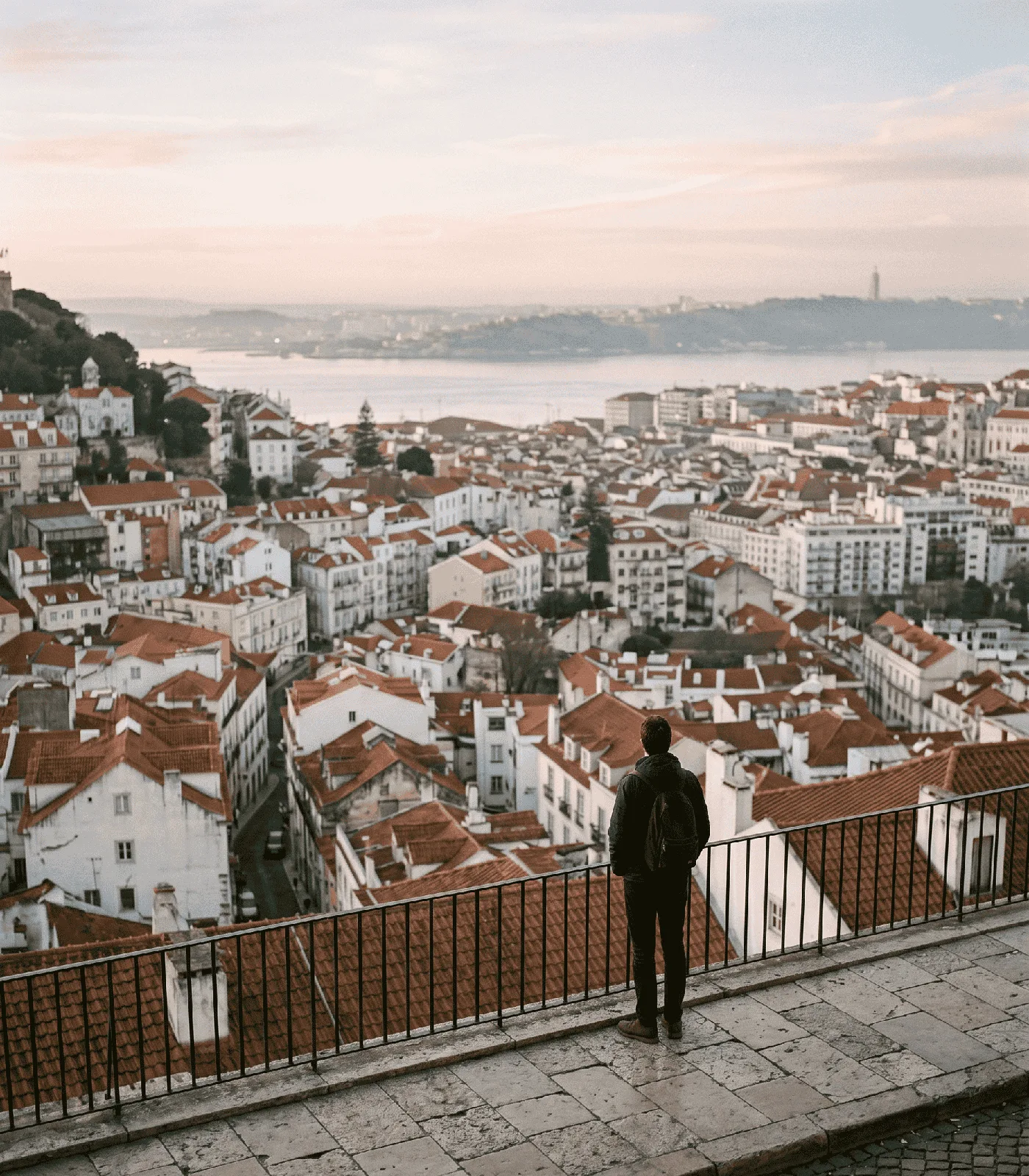
The light in Glasgow does not flatter things. It does not do what the light in Lisbon does, which is to make everything slightly more interesting than it actually is — the crumbling wall, the laundry, the taxi rank — by landing on it at an angle so precise it might have been designed. Glasgow's light is flat and even and patient. It does not have favourites. It illuminates everything equally, without enthusiasm, and then it rains.
This turns out to be very good for working.
The rooms in Glasgow — the tenement flats of Govanhill, the converted warehouses on the south side, the high-ceilinged Victorian flats in Hyndland that have not yet been subdivided — are lit by this flat grey patience for most of the year, and the effect on concentration is something that took several visits to understand. The light does not compete with the work. There is no moment at eleven when the sun moves and suddenly the desk is too bright, or when the golden hour begins and the room becomes too beautiful to ignore. The light simply is, all day, at roughly the same level, and this steadiness turns out to be one of the most useful qualities a borrowed room can have.
What the tenement flat offers
The Glasgow tenement was built between roughly 1870 and 1914, mostly in red or golden sandstone, and was designed — not deliberately but structurally — with rooms of a particular proportion that are extremely good to work in. The ceilings are high. The windows are large. The rooms are deep rather than wide, which means that the light penetrates the back of the room more evenly than in shallower buildings. The walls are thick enough to provide both insulation and sound dampening, and the floors — original boards where they survive — have the specific resonance of wood that has been walked on for a century and absorbed some of that into its character.
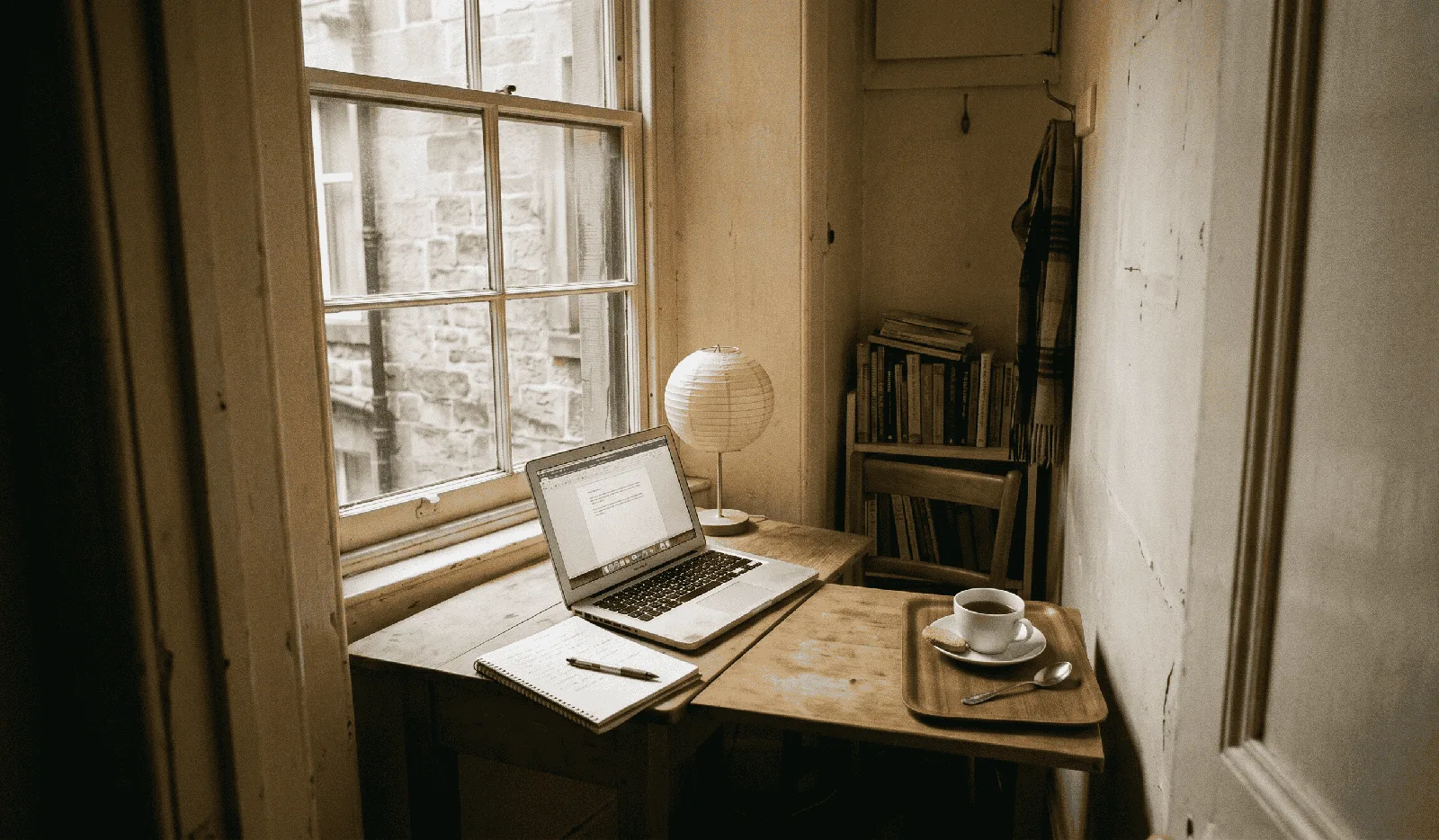
There is a particular Glasgow tenement room — a back bedroom or a spare room, generally — that recurs across the city with enough consistency to be recognisable as a type. It has one large sash window facing either a shared back court or a quiet lane. It has one overhead light that is either not working or fitted with a bulb of 40 watts or less, so the room defaults to natural light. It has a desk or a table that has been in the flat for so long that it has acquired the status of a fixed object rather than a movable one. And it has the quality, common to rooms that have been occupied by people who took work seriously, of knowing what it is for.
The best working rooms in Glasgow do not announce themselves. They are simply rooms where something useful has been done, repeatedly, over a long period of time, and the room has settled into that purpose the way a good chair settles under the weight of regular use.
On the rain as a working condition
The rain in Glasgow is a separate subject from the light, but it is related. On days when it rains — which is most days between October and April, and a significant proportion of days in the other months — the borrowed room becomes not merely useful but necessary. There is nowhere else to go. The café is damp and crowded with other people who also have nowhere else to go. The park is not an option. The city outside is managing itself perfectly well and does not require your participation.
This enforced interiority, which in other cities is a minor catastrophe, is in Glasgow simply the condition. It focuses the day in a way that no amount of intentional productivity management quite achieves. The rain is outside. The work is inside. The distinction is clear and maintains itself without effort on your part.
Several of the best working days in this journal's recent history have been in Glasgow, in rooms facing back courts, in November, with the rain doing what it does and the flat grey light doing what it does and the work moving at a pace that would have been difficult to sustain anywhere sunnier. This is not a coincidence. It is an argument for the grey cities that the travel writing industry has not yet found a way to make look appealing in photographs, and that are therefore cheaper to visit and less crowded to work in, and that reward the person who stays long enough to understand what the light is actually doing.
A note on the city itself
Glasgow is funnier than any other city in this guide. This is not a working condition exactly, but it is worth noting because it affects the quality of the evenings — the pubs, the conversations, the particular Glasgow willingness to say something true in a way that makes you laugh — and the quality of the evenings affects the quality of the next morning. The borrowed room is better when the city around it is generous. Glasgow, despite its reputation for weather and its tendency to present itself through a specific kind of municipal grimness, is one of the most generous cities any of us has worked in. The rooms reflect this. They are offered readily and maintained carefully and returned, in most cases, to hosts who are pleased to have had you in the room and say so directly, without ceremony, which is the Glasgow way of doing most things.