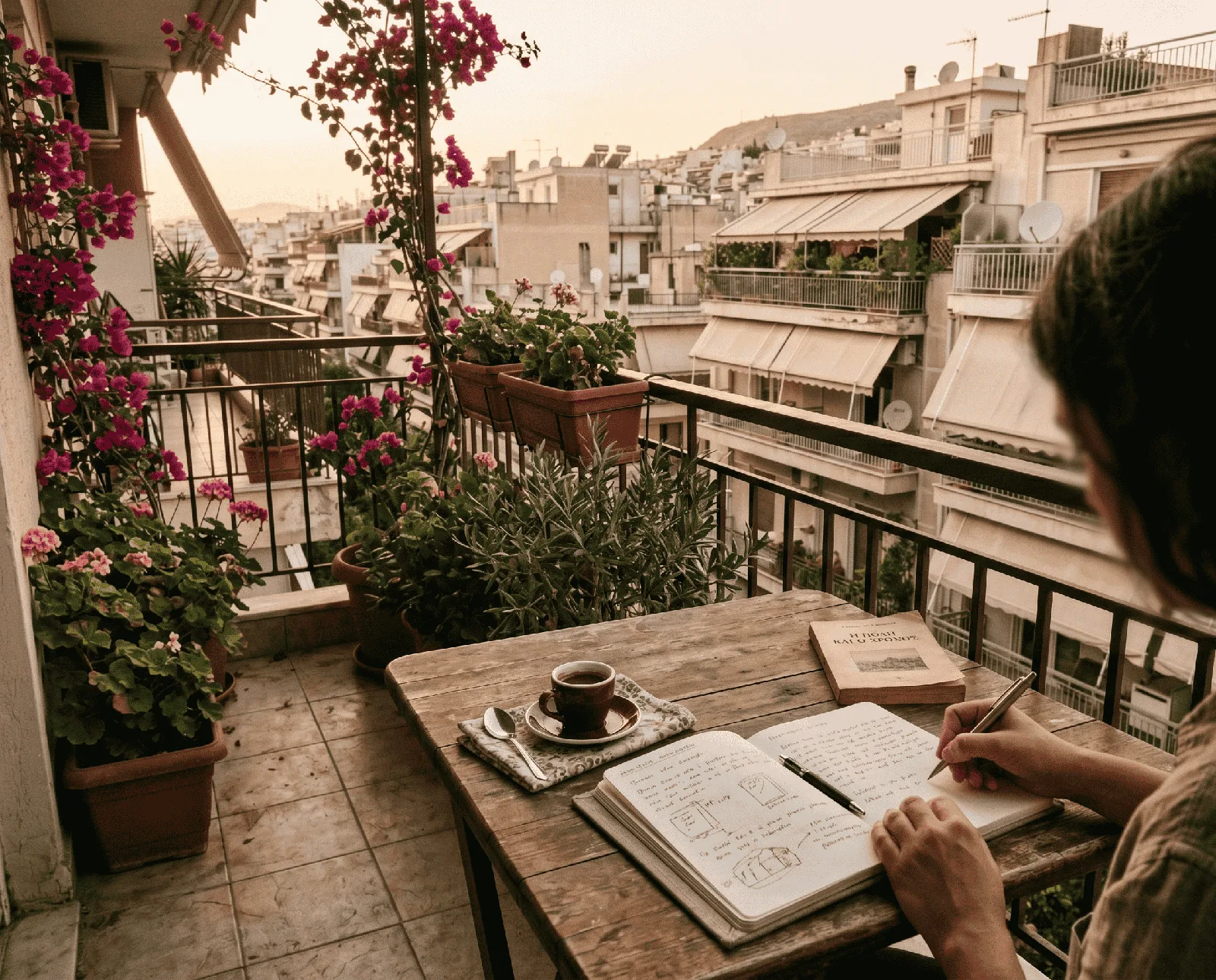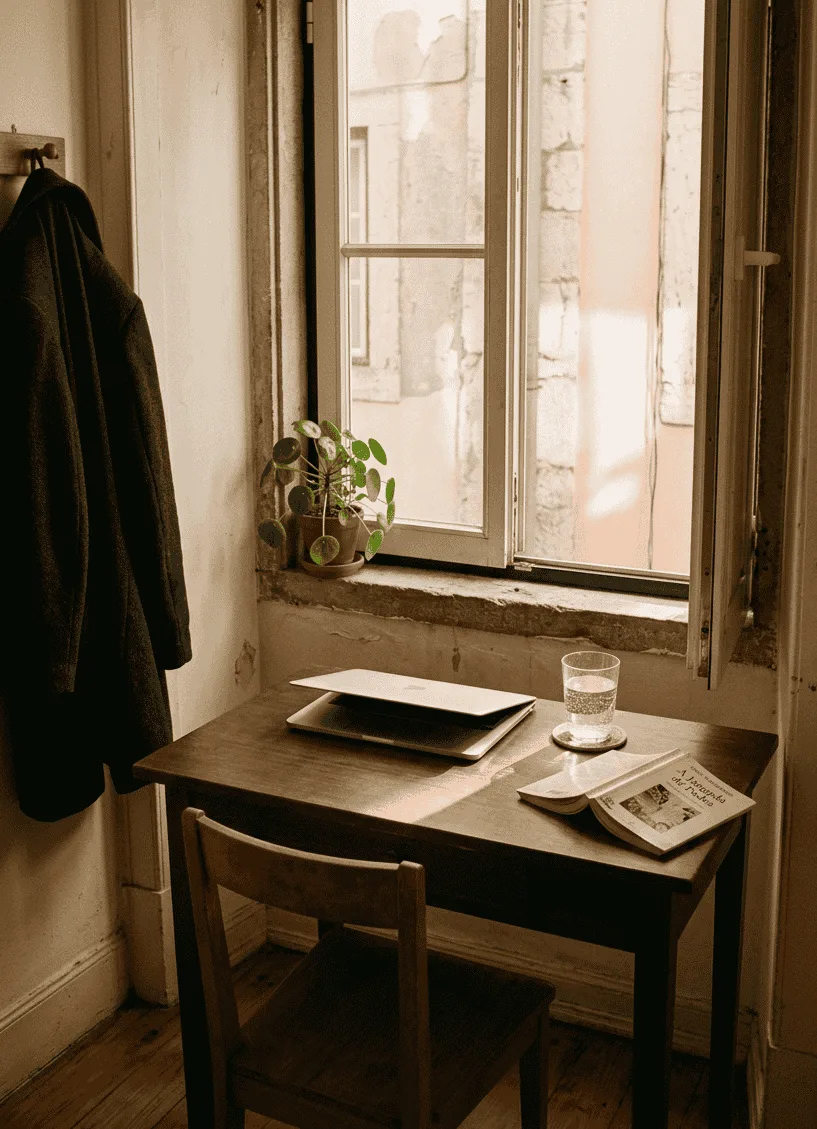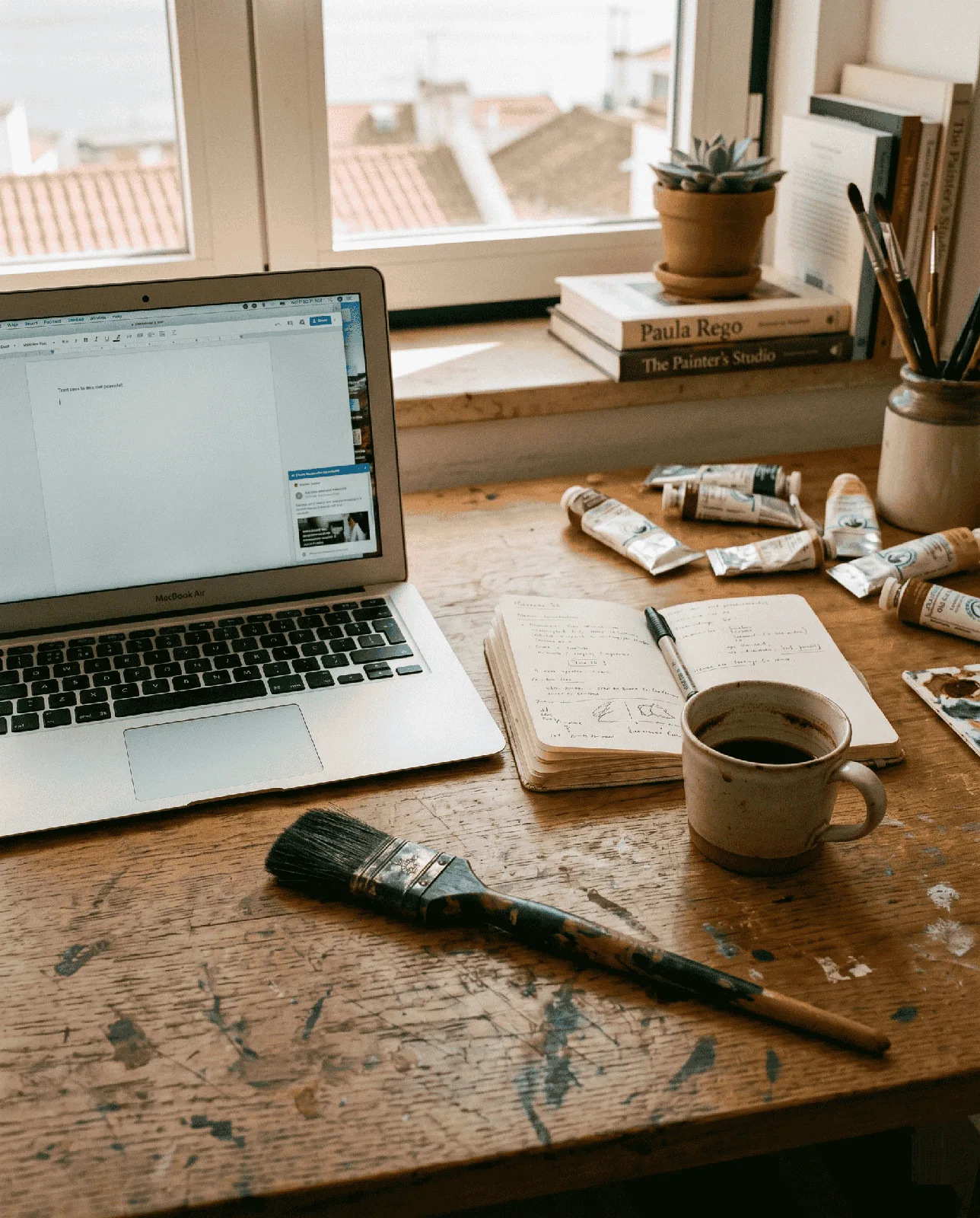
There is a particular quality to borrowed rooms in the hour before noon that is difficult to describe without sounding slightly unhinged. The light is still oblique. The city outside has committed to the day but not yet made demands of anyone sitting at a desk near the window. The host, if there is one, has generally left for something. The previous evening’s washing-up has been done and the room has reset itself into a clean and unclaimed state. This is, we have found, the most useful window of any day spent working in someone else’s space.
It is not the earliest hour, which is its own different gift — quieter, colder, faintly heroic — but also precarious, because you have not yet fully arrived at the work and the day has not given you its middle-distance focus. The hour before noon is better. You have had coffee. You have handled one or two small things that needed handling. The morning’s first anxiety has burned off. What remains, if you are working in the right room, is a kind of attentive readiness that rarely visits you at a desk you own yourself.
On the strangeness of borrowed time
We have spent enough days now in rooms that aren’t ours to notice a pattern. The first hour in any new space is exploratory — you are still reading the room, learning its light, noticing which chair is the correct one and whether the desk is at the right height and what the ambient sound situation is likely to be for the rest of the day. The last hour, whenever that falls, carries a faint valedictory quality. But the middle of the morning, roughly from nine until eleven or so, is when the room stops being interesting and starts being useful.
This is not a small distinction. A room that is interesting occupies part of your attention. You are observing it, enjoying it, writing mental notes about the particular way the light pools on the windowsill or the particular quality of the street noise below. This is not work; it is observation, which is its own valuable thing but requires different conditions.
The room that has stopped being interesting has started being yours. Not permanently, not by any formal arrangement — but provisionally, for the hours you have been given, it is simply where you are and where the work is happening.
What changes at eleven
Something shifts, in most borrowed rooms, somewhere around eleven. It is not always the same thing. Sometimes it is the host returning for lunch, which changes the air in any shared space. Sometimes it is the street noise reaching a different register — the market arriving below, the school run completing and converting itself into something busier and less rhythmic. Sometimes it is the light, which by mid-morning has moved past the oblique and become direct and rather harsh, and the desk you were sitting at is now either too bright or — if the window is behind you — positioned in a way that no longer works.
In a room in Istanbul last November, the shift came at exactly eleven fifteen, when the morning call finished from the nearby mosque and the café two floors below seemed collectively to decide that it was time for something more industrious. The quiet that had obtained since nine simply ended. The work that remained could be done in the afternoon, but it was different work — more mechanical, more editorial, less whatever-the-other-thing-is that requires the oblique light and the reset room.
A room in Lagos had a different eleven. There, the heat arrived with something like intention — the mornings cool and workable until around that time, then building quickly into something that required the ceiling fan on its highest setting and made sustained concentration more effortful. The early-morning hours there began before eight, and the productive window was correspondingly shorter. But in that window, the work moved quickly. The heat coming was a kind of deadline.
Toward a theory of borrowed mornings
It may be that what borrowed rooms offer, specifically in the morning, is the gift of displacement. At a desk you own, you know what you are supposed to be doing and the knowing is a small but persistent weight. At a desk in someone else’s apartment, in a room you are using for a few days before moving on, the usual expectations do not entirely apply. The work you brought with you is the work you have. There is nothing else to attend to. No other pile of things accumulated on this desk, because it is not your desk, and your piles are elsewhere.
This is, we think, what the borrowed room offers that cannot be replicated in a serviced office or a dedicated coworking space, both of which are generically yours by arrangement and thus carry the same ambient weight of expectation as any other place you regularly occupy. The rented desk in a coworking space is a desk you have agreed to sit at. The kitchen table in someone’s flat in Athens is a desk you have been trusted with. The distinction, for the purposes of the work, is considerable.
The hour before noon in a borrowed room is when you discover whether that trust was well-placed. It almost always turns out that it was.